
Industry research
Scope
US
Companies
78
Table of contents
What does the e-procurement & expense management market landscape look like in the US?
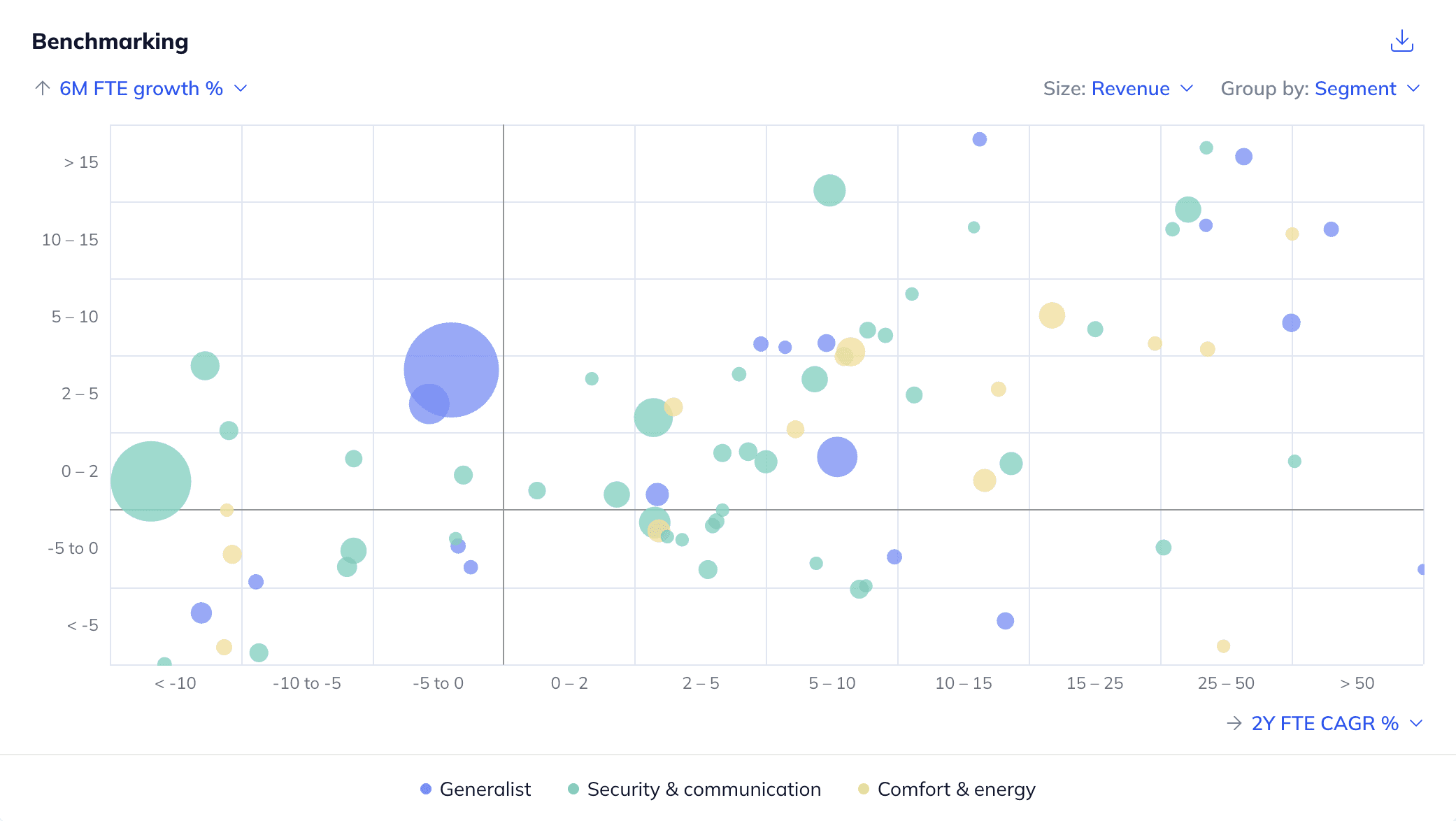
The competitive landscape remains fragmented across all segments, with leadership emerging at the sub-segment or functional level rather than through fully consolidated end-to-end platforms. To illustrate, Lutron leads the premium residential lighting category, while ADT and Amazon (through Ring) lead the US home alarm security systems market. In parallel, large integrators (e.g. Bravas) layer designs, installation and servicing of multi-vendor systems and act as the primary route to market for high-end and custom deployments rather than competing through proprietary platforms. Additionally, incumbents face competition from scaled national and regional peers as well as large technology and industrial groups, including Samsung (KR), Alphabet (US), Schneider Electric (FR), Bosch Group (DE) and ABB Group (CH), which exert influence through ownership of core control layers such as operating systems, voice assistants, developer ecosystems and user identity frameworks. Large pure-play home automation players often pursue acquisitions to expand their geographic footprint and strengthen service offerings. For instance, Per Mar Security Services has completed multiple acquisitions of regional alarm providers across the Midwest. Conversely, smaller players typically compete through specialization, local service depth and a focus on specific use cases. For example, Electronics Design Group focuses on bespoke full-home integration for high-end clients, while Deako specializes in builder-installed smart switches for new homes.
What is the level of investor activity in the US's e-procurement & expense management industry?
Sponsor-led interest remains limited, with ~35% of identified assets being investor-backed (January 2026). Herein, investors are attracted to (i) structurally higher residential electricity loads and electrification trends that reinforce demand for energy visibility and control, (ii) advances in AI that enhance system usability and enable context-aware automation across lighting, security and climate control, (iii) improvements in interoperability standards, including Matter support, which reduce setup friction and enable broader mixed-brand deployment in households and (iv) the expansion of recurring subscription and software-driven revenue models tied to monitoring, analytics and platform services. Key detractors include (i) persistent data privacy and cybersecurity concerns that constrain household willingness to deploy always-connected devices at scale, (ii) elevated raw material and electronic component costs that pressure device pricing and slow adoption and (iii) stagnant US housing turnover from the “mortgage rate lock-in” effect that limits natural trigger events for new home automation installations.
What are the key ESG considerations in the US's e-procurement & expense management industry?
ESG considerations in the US home automation market revolve around the balance between energy-efficiency benefits and environmental costs embedded in system deployment and lifecycle management, alongside material social risks related to consumer privacy and data security. While smart home systems support reductions in household energy use through intelligent control of HVAC, lighting and loads, increased device density and cloud processing raise energy use and e-waste considerations. Social risks remain salient given the collection of granular household data and uneven consumer understanding of data practices, driving a growing emphasis on privacy-by-design architectures, local processing and strengthened data-governance frameworks across leading platforms.
Technavio (July 2025) estimates that the US smart home market size generated ~$20.7bn in revenue in 2024 and expects it to grow to ~$27.2bn by 2029 (+5.6% CAGR 2024-2029)
The US residential security market was valued at ~$17.0bn in 2024 and will reach ~$23.0bn by 2029 (+6.2% CAGR 2024-2029; ADT, April 2025)
Persistently high residential electricity prices and the expansion of utility-run demand-response programs will support the growing adoption of automated energy control systems. Smart thermostats, load controllers and home energy management systems are expected to gain relevance as usage optimization directly reduces household energy costs (Schneider Electric, November 2025; Realtor, August 2025)
Advances in AI enhance the capabilities and usability of home automation systems by enabling devices to learn from user patterns, anticipate needs and automate functions such as lighting, security and climate control. AI-driven analytics and machine learning allow systems to move beyond basic remote control toward context-aware operation, improving efficiency, personalization and responsiveness in everyday residential use cases (Avtek.ie, November 2025; Inoxoft, September 2025)
Advancements in interoperability standards are expected to reduce setup friction and support broader adoption of US home-automation systems. As Matter support expands across additional device categories, including security cameras, doorbells and lighting, mixed-brand deployments become more reliable and reduce barriers to mainstream household adoption beyond early adopters and hobbyist users (Granite River Labs, November 2025; Connectivity Standards Alliance, November 2025)
Persistent data privacy and cybersecurity concerns are expected to constrain broader adoption of home automation systems. Risks around unauthorized access, surveillance and misuse of household data remain salient for US consumers, limiting willingness to deploy always-connected cameras, microphones and sensors across multiple rooms and residential use cases (Canary Trap, May 2024)
Elevated raw material and electronic component costs are expected to impact device pricing and slow residential adoption of home automation systems. Higher input costs for metals and semiconductors, coupled with ongoing supply constraints, reduce vendor pricing flexibility and delay large-scale deployment (Supply Chain Daily, December 2025; Astute Group, November 2025)
Stagnant US housing turnover driven by the “mortgage rate lock-in” effect is expected to suppress natural trigger events for new home automation installations. With many homeowners reluctant to sell or relocate due to historically low existing mortgage rates compared with current market rates, housing transactions and mobility remain near multi-decade lows, reducing opportunities for whole-home smart system retrofits and builder-integrated deployments (Cotality, December 2025; Inman, September 2024)
With the full report, you’ll gain access to:
Detailed assessments of the market outlook
Insights from c-suite industry executives
A clear overview of all active investors in the industry
An in-depth look into 78 private companies, incl. financials, ownership details and more.
A view on all 198 deals in the industry
ESG assessments with highlighted ESG outperformers